Kevin's Online Cookbook

bar

My Life Story, Disclaimers, blah blah blah

I had a bad diabetic keto-acidosis "incident" starting in 2017.  I think a lot of Americans are headed in the same direction.  Don't try to deal with diabetes without the help of medical professionals who know your individual case.  HOWEVER, that being said, changing my diet was a tremendous help in controlling my diabetes and there is a lot of evidence that a better diet [than the standard American] can help people stave off diabetes who might be headed that way.  A lot of friends who eat with me or cook for me seem to get confused easily about what's a good diet for me.  I wrote this page not only to store my own recipes for convenience, but also to explain the reasoning behind my diet.  I hope this is useful for everyone!
Government Disclaimer
Obviously I'm not a doctor or a nutritionist.  Consult experts.  I believe everyone's metabolism is kinda unique, so this is what works for me.  Experiment a bit and find what works for you. Not everything will.  Read at your own risk!

I have written this page with click-able categories and Question boxes which you can expand for more details.  Feel free to ignore any question you're not interested in. 

Recipes Like
                  Sci-Fi
FAQ #1

What's Diabetes?

Diabetes is a problem with a person's Insulin system (i.e., the Pancreas).  The Insulin system processes & digests glucose, which in layman's terms is basically sugar in its purest form.  Glucose is the fuel from which all human cells derive energy for their work, including both the muscles, and also the brain.  But not all glucose comes from sweet or sugary foods.  Starches, which tend to taste savory, are multiple glucose molecules bound together.  Glucose is found or can be extracted by your body from carbohydrate (carb) foods, and carbs tend to come from plants.  Animal products like meat and cheese are basically composed of protein and fats.

How Important Is Gluose?

Human food is composed of at least one (usually a combination) of three "Macro-Nutrients":  Either Proteins; Fat (/Oils); and/or Carbohydrates (carbs).  If it doesn't contain at least one of those three, it isn't food.  Things like vitamins and minerals and enzymes, are "Micro-Nutrients".  You need them to survive, but only in small quantities.  The substance of your food is proteins, fats, and/or carbs.  Glucose (derived from carbs) is the fuel of your body's cells, but in very high concentrations it becomes toxic to your cells.  On the other hand, if you don't have enough glucose, your cells stop functioning (including your brain or important muscles like your heart).  Glucose moves through your body via the bloodstream.  Insulin makes sure the glucose goes where it's needed.  Since a diabetic has problems producing Insulin, she must walk a delicate balance.  She can't fall too low on glucose or else her body stops functioning.  But due to the Insulin problem, she can't process and eliminate glucose as quickly as a non-diabetic.  She has to make sure her blood glucose doesn't "spike," in other words, when a large amount of glucose hits the bloodstream all at once.  Or else the glucose acts like a toxin on her body.  Whereas the Insulin system of a normal non-diabetic person can process the extra glucose before it becomes toxic. 

Glucose is derived from carbs, and carbs can vary from "Simple" to "Complex" carbs.  This trips up a lot of people, but I don't think it's difficult.  Try not to over-think it.  What that means is, how fast does the glucose in the carb hit your bloodstream?  Sugar hits your bloodstream instantly and gives you quick energy, or even a 'sugar high'.  Yet it takes a long time to digest fiber, right?  But still, sugar and fiber are both from plants.  They're both carbs, but different kinds of carbs.  Fiber is a "Complex" carb.  Sugars and some starches, (which tend to be white in color) are "Simple" carbs and hit your bloodstream almost instantaneously.  "Refined" carbs are also carbs which were Complex in the raw ingredient... (like say, whole grain wheat), but have been processed in order to make them into "Simple" carbs (like say, white bleached flour).  So refined white sugar, and starches such as white (refined) flour, potatoes, rice, and corn -- these are all "Simple" carbs by the time you buy them, and they are all bad for a diabetic to eat.

By contrast, "Complex" carbs take many minutes or even an hour to hit your bloodstream.  They hit your bloodstream so slowly, that they're safe for a diabetic to eat. 

What's the Problem with Glucose for Diabetics?

Americans eat too many Simple / Refined carbs, and that's all there is to it.  Unscientifically, unofficially, many people believe that Type II diabetes (a.k.a. "Adult Onset Diabetes") occurs when your pancreas gets "burned out" from eating too many simple/refined carbs for too many years.  (Type I diabetes is a congenital problem with the pancreas/insulin -- in other words, you're born with it.)  Insulin is a hormone, and hormones vary greatly from person to person.  Also the same person's hormone systems perform differently as they age. Some people with a robust insulin system can eat Simple Carbs their whole life and never have a problem.  However, for a lot more people, their Insulin hormone system slows down as they age, and doesn't perform as well as they used to.  Maybe you could gulp down sugar and junk food starches like a maniac, when you were younger, and you still stayed thin at that time.  Partly because you were more active (muscle activity, exercise, burns off glucose, that's its function).  Nowadays you're an adult with a sedentary job, you are gaining weight and your doctor doesn't like your blood-work -- MAINLY because you're getting older and your hormones are naturally changing, while you also haven't given up your junky carbs.  Secondarily, because you're not as active.  (There is a lot of evidence that one cannot "exercise your way out" of a bad diet of junk food, processed / refined / Simple Carbs.  But that's a huge discussion in itself.  Don't count on exercise to save you without the foundation of a very healthy diet.)

Since there are only 3 basic Macro-Nutrients, and a diabetic must eat less carbs, that means she has no choice but to eat more protein, and/or more fats.  It's a zero-sum game.  Eating fewer carbs means eating more of the other two.  A "keto" diet puts the body into a state of ketogenesis, which digests fat.  Every normal human goes into ketogenesis, typically at night when you're sleeping.  Your body's ketogenesis system digests both dietary fat, and stored body fat.  Which is why a lot of people lose weight/fat on a Keto diet.  Body fat is composed of multiple glucose molecules bound together. (Some are called "triglycerides," three glucose molecules bound together.) A Keto state is nothing to be afraid of; only if it gets far out of balance. 

How does a "Keto" Diet help?

The point of a Keto diet is not necessarily to eat _more_ protein, but to eat less carbs, and to "rev up" the ketogenesis system.  If a person eats tons of protein, their body starts converting the protein into glucose, which has the same problems as eating too many carbs.  So in fact, the _real_ point of a Keto diet is to eat more fats.  Some fats are healthier than others, but in general dietary fats have gotten a bad rap due to bad science from the 50s.  Emerging science suggests that eating fats doesn't necessarily cause heart disease.  In fact, emerging science also suggests that simple carbs cause heart disease, via inflammation.  But the medical establishment is over-cautious and very slow to change course, so you still see "Low-Fat" foods everywhere... (avoid them!)  and many doctors still tell you to cut down on eating fats.  A diabetic person _NEEDS_ to eat healthy fats (which tend to be natural plant-based fats). An example of a plant with a lot of healthy fat is an avocado. 

Foods rich in proteins and fats, such as meat & dairy, tend not to have any Micro-Nutrients (like vitamins and minerals).  You only get those from plants.  So even a diabetic _MUST_ east "some" carbs.  A diabetic needs to eat "the right" healthy carbs, in order to be sure her limited carb intake delivers enough Micro-Nutrients.  Also Americans never seem to eat enough Fiber, and Fiber counts as a carb (albeit a Complex Carb).  So, some vegetables (which deliver nutrients & fiber) are better for a diabetic to eat than others, and so there is a "spectrum" of vegetables (see the next section) that are better or worse for a diabetic to eat.

The "Virta" diet is a good example of a keto diet for diabetics, and some of my recipes come from there.  The Virta diet wants you to eat _only_ 30g of Carbohydrates per day, whether they're simple or complex carbs.  30g of vegetables is something like a large plate of salad greens -- _NOT_ including any sugary dressings, nor bougie add-ons like cranberries or croutons.  That plate of greens is all the carbs they recommend you eat in a whole day, so you've got to make sure the carbs you eat _COUNT_ , and pack a large bang-for-the-buck in terms of nutrients.

IN CONCLUSION, a diabetic diet seeks to emphasize fats and proteins, and to eliminate Simple / Refined Carbs, or substitute Complex Carbs for Simple / Refined Carbs.

This is often difficult to do because, you might notice, if you walk into a typical American grocery store, what you see is something like 80% carbs, and most of those carbs are Simple / Refined Carbs.  Americans eat a lot of sweets.  Fast food and even a lot of restaurant food tends to emphasize Simple / Refined Carbs.  There is some evidence that Simple / Refined carbs are literally addictive, so that's why companies offer them so much.

Go
                  Vegan
More FAQ's

  • What Is a "Keto" diet?    A Keto diet seeks to put the dieter in a state of "ketosis" for as much time as possible. Your body has an order of preference. Remember (from above) that there are only three basic components of food. If Simple Carbs are available in your stomach, your body GREATLY prefers to digest those, because they give you quick and easy energy. If there aren't many Simple Carbs available in your stomach, your body will "make do" with Protein and convert it into glucose. If neither of the above is easy at hand, then your body moves to a process of digesting fats, which is called Ketosis. (The same Ketosis process digests both dietary fats in your food, and also gets rid of body fat.) Fats, as mentioned, store glucose. So fats are a source of a lot of energy. But your body is loath to burn them, because those are your long-term reserves, to be saved for emergencies like famines. Your body puts glucose into your body fat stores pretty easily, (if your Insulin system is robust), but your body doesn't want to burn up those body fat stores unless there's no other choice. Americans eat too many Simple Carbs, which get stored into body fat. Having too much body fat & simple sugars, hanging around for a long time, stationary, stale, stagnant... in your cellular reserves, in your muscles, in your bloodstream... instead of circulating in and out as you use it and burn it... _that_ causes the health problems which we all hear about.


  • So how do we put your body into a state of "Ketosis," where you burn fat instead of accumulating it? First, you cut out the Simple Carbs, which get transformed _READILY_ by your body into fat. If your body is busy transforming simple carbs into fat, it DOES NOT activate the system that digests fats & oils. Your body cannot do two opposite things at once. hen you cheat and eat Simple Carbs, your body switches to digesting those Simple Carbs and never goes into Ketosis. Second, there's evidence that your body "revs up" whichever of the three digestion processes, matches the food that you're eating. So, if you eat a lot of healthy dietary fat, your body "revs up" the Ketosis system, and you burn that fat out of your storage.

    Keto diets recommend you add extra dietary fat to any food that can accept it. Garnish or season your meals with Guacamole, sour cream, mayo, butter, and other fats.

  • But don't you burn fat with exercise?  Yes, BUT.  I just mentioned that your body has an order of preference. When you exercise, your muscles burn glucose -- yes. But if your diet is primarily Simple Carbs... even supposedly "healthy" simple carbs like, say, wheat, potatoes, rice, corn... then your body NEVER goes into Ketosis and you never burn up your reserves of body fat. Not even during exercise. And as mentioned, if you keep building up your body fat reserves and never burn them out and get rid of them, it causes the health problems that all Americans hear about constantly. Exercise has tons and tons of medical benefits. But if the fuel you burn for your exercise comes from a constant intake of simple carbs, you can exercise all day long and STILL NOT burn the stored fats. And that causes the health problems.


  • Is "Gluten-Free" good for a diabetic?  Not really.  Gluten intolerance / "gluten-free," versus diabetic, are entirely separate issues and have nothing to do with each other.  Gluten is actually a protein, so cutting out gluten doesn't help you cut carbs.  Gluten is a protein which binds carbs together and gives bread-type products a better structure (more spongy, cake-like) and better mouth feel.  There isn't any point for a diabetic or Keto dieter to avoid Gluten, unless of course you are intolerant/allergic to it.  Note that a pinch of "Xanthan Gum" helps keto/diabetic bread-type products (for example, muffins made from almond flour instead of wheat) to feel more spongy and cake-like.  Other tips are found on this page near some bread recipes.

  • Can a diabetic or keto dieter be a Vegetarian?  Yes, but it's pretty darn difficult.  A diabetic needs to eat extra protein and healthy fats, whereas vegetables are composed mainly of carbs.  An "Ovo-Lacto" Vegetarian (eats eggs & dairy), or a "Pescaterian" (eats fish in addition to vegetables) has a much easier time with diabetes/keto than a strict vegetarian.  Beans (including tofu) contain a lot of protein, but some people advise avoiding beans & legumes like peanuts -- because they contain phytic acid and lectins.  These compounds block your absorption of certain other nutrients, so some people refer to these as "anti-nutrients".  Nuts contain a good amount of both protein and healthy fats.  But they also contain carbs, so a diabetic shouldn't eat them to excess.  Yogurt is a good source of protein, but a minority of vegans don't consider yogurt to be vegetarian.  Spirulina algae is a good vegetarian source of protein.  Most vegetables contain _some_ protein, just not a lot.


  • Note that there is _NO_ official "international standard" or "committee" to decide if a commercial food product is "Keto" or not.  Unlike "organic" foods, where at least there are laws and standards.  Some processed food products on grocery store shelves which are labeled "KETO" are most definitely _NOT_ Keto.  It's ideal to cook for yourself so that you know exactly what you're eating.  But when buying processed foods, be sure to check the nutrition labels and look for excessive carbohydrates _even_ if the food is labeled "Keto".


  • That being said:  Several different store-bought brands of "Keto Sandwich Bread," buns, and "Keto Tortillas" are now available.  And they seem to be 'benign' so far, and those are a HUGE help to living with a keto / diabetic diet.  Because so many normal recipes rely on some kind of a starch like bread or tortillas to hold food together.


All diets are a compromise, unless you're some kind of professional athlete in training.  If the diet is too unappealing or too difficult, the normal dieter won't stick to it, period-end-of-story.   The goal is to try to enjoy more of the "good" foods, and let them naturally displace the "bad" ones out of your diet.  Rather than go cold turkey or eat weird supplements and powders or other weird concoctions that would make your grandparents think you're crazy.  
The Spectrum

As noted above, carbs can vary from "Simple" to "Complex," and some have more nutrients than others.  So that's why I think of vegetables, foods, and recipes on a "SPECTRUM". 

You could eat healthy by making most of your meals as a plain grilled chicken breast, lightly oiled and seasoned, and throw in small servings of healthy veg like kale for vitamins and fiber.  But you don't need me to tell you that.  AND you're not going to stick to that. Even those cutting carbs need to eat some healthy veg, for nutrients which meat & dairy don't provide.  It's a trade-off or a ranking or a compromise.  The spectrum that appears here, is loosely based upon work found at Low Carb Diets , and some of this is my personal results. 
---- Best veggies are at the top:

  • Sprouts: bean, alfalfa, etc.
  • Greens: lettuces, spinach, chard, etc.  Radicchio and endive count as greens.
  • Hearty Greens: collards, mustard greens, kale, etc. 
  • Herbs: parsley, cilantro, basil, rosemary, thyme, etc.
  • Bok Choy
  • Celery
  • Radishes
  • Sea Vegetables:  Nori, etc
  • Cabbage or sauerkraut
  • Mushrooms
  • Jicama
  • Cucumbers, or pickles without added sugars
  • Asparagus
  • Green Beans and Wax Beans
  • Fennel
  • Broccoli
  • Cauliflower
  • Water Chestnuts
  • Scallions or green onions
  • Bamboo Shoots
  • Leeks
  • Spaghetti Squash
  • Summer Squash
  • Peppers: both hot peppers, and Green / Red / colored Bell Peppers
  • Chickpeas / Garbanzo Beans
  • Brussels Sprouts
  • Tofu, soy in various forms (e.g. tempeh), edamame
  • Nuts & snack seeds: cashews, peanuts, sunflower seeds, etc. etc.  These tend to contain carbs as well as fats & protein, the "hat trick"
  • Zuchini
  • Snow Peas (pods)
  • Lentils (there is debate over their rank)
  • Eggplant
  • Onions
  • Avocados
  • Olives
  • Beans (of virtually all types)
  • Tomatillos
  • Tomatoes
  • Artichokes
  • Okra

 ---- The "least best" veggies are at the bottom... 
But note, these are still acceptable.  The REAL worst, the things a diabetic should try hard to avoid, are found at the upper-right of this spectrum as "starchy vegetables" and grains and breads and fruits, and other categories over there.

Some other FAQ:  Store-bought Kombucha tends to be sweetened and store-bought is generally not recommended.  However, homemade or locally made high-quality kombucha frequently doesn't contain much sugar -- because the yeast during the brewing process has naturally consumed the sugar.  These low-sugar kombuchas are tart and vinagery.  I recommend homemade or locally made small-batch kombucha.


The short version is,
  • + Meat, cheese, and yogurt are good for diabetics and keto dieters. And they don't have to be lean meats or 'Skim Milk' Mozzarella or low-fat yogurt. In fact, they shouldn't. Fat is a diabetic & keto dieter's friend.
  • + Coconut oil & avocado oil are recommended for sautée and cooking recipes.  Olive oil is healthy but only at low temperatures.
  • + Keto dieters and those who cut out processed foods & carbs need to consume a bit more salt, as opposed to most Americans who need to cut down on salt.
  • - Cow's milk isn't great for diabetics & keto.  Recommend oat milk & flax milk instead.  Here's how to make your own Plant-Based Milk with nuts of your choice.
  • - Limit breaded meats such as McNuggets®, veal cutlets, fried chicken, etc. Keto substitute recipes are available.
  • - Avoid sugary sauces such as barbecue sauce, orange sauce, etc.  Keto substitutes are available. Check how much sugar is in your salad dressing.
  • - Avoid margarine and artificial creamers.
  • - DON'T go on a "Carnivore" diet like Jordan Peterson.  Many vital nutrients are found only in plants.

For more detail, click here.


Important to repeat:  my recipes also follow a "Spectrum".  Not all my recipes are strictly healthy, nor vegetarian, nor Keto.  But they're useful to me.  Use your judgment in navigating them.  Of course this is a work-in-progress.  I will add more recipes and tips as much and as soon as I can!

Breakfast Recipes

Here is some info about Breakfast.


Quick Tip:  When I'm not feeling creative or energetic, I will make my own "Egg McMuffins®" very simply.  Toast a piece of Keto Bread or a Keto Hamburger bun, spread it with mayonnaise, add any other flavorful sauce you like (such as salsa or maybe pesto?)  Fry an egg and sprinkle it with some spices such as black pepper, Parmesan, oregano, or rosemary.  Plop the fried egg onto the bread, and cover it with (optional) ham or bacon or sausage, etc., and top with a thin slice of cheese.  I like them open-faced but you could put another slice of bread on top.
Lunch Recipes

Quick Tip:  When I'm not feeling creative or energetic, I often tend to make regular lunchmeat sandwiches on keto bread.
As noted elsewhere, there are now pretty good keto bread replacement options in grocerty stores.  Keto breads and buns; keto and low-carb/"carb balance" tortillas; tortillas made of egg crepes (e.g. "Crepini"), tortillas made of thin but flexible circles of cheese.  Experiment to find which works best for you, and switch it up every now and again.
Dinner Recipes

Here is some info about Dinner.


Pizza Possibilities!  The white flour used in traditional pizza crust tends to spike my blood sugar severely.  Gluten-Free pizza crust is available, but as mentioned this doesn't really help diabetics or keto dieters.  I have a recipe for Plantain Bread that works as a mini-pizza crust, and there are now Keto breads and tortillas in many stores which don't spike my blood sugar.  (A Tortilla Pizza is a legit thing!)  Pizzas or bake-at-home crusts from Cauliflower are also available in some stores, which have advanced in quality.  You can also consider putting pizza toppings on whole wheat WASA crackers, on large roasted cauliflower or eggplant medallions, or large Portabello mushrooms.
Dips, Sauces &c.

Here is some info about Sauces.


Keto Pasta Substitutes:  Notes on Keto options for Pasta are found elsewhere on this page, also with the recipe here for Unusual Pasta Sauces.
Some examples include "Shiritaki" protein noodles; some pastas made from chickpeas or quinoa; Asian noodles from alternative flours.  Be sure to check the carb content and experiment to see which ones spike your blood sugar; because some "Keto" products are definitely not keto.  Homemade options include, squash cut with a spiral cutter; or thin sliced green beans.
Dessert Recipes

Yes, diabetics can have dessert!

bar

Foxtrot Alternative
                  Cooking
Dogbert Vegetarian
Singer
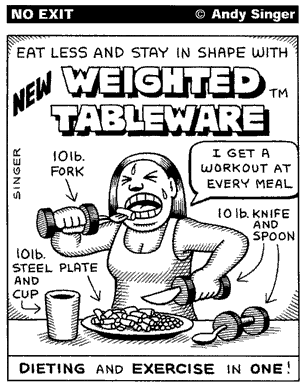
                    Weighted Tableware Cat is not vegetarian
KFC
                  Witness Protection Program
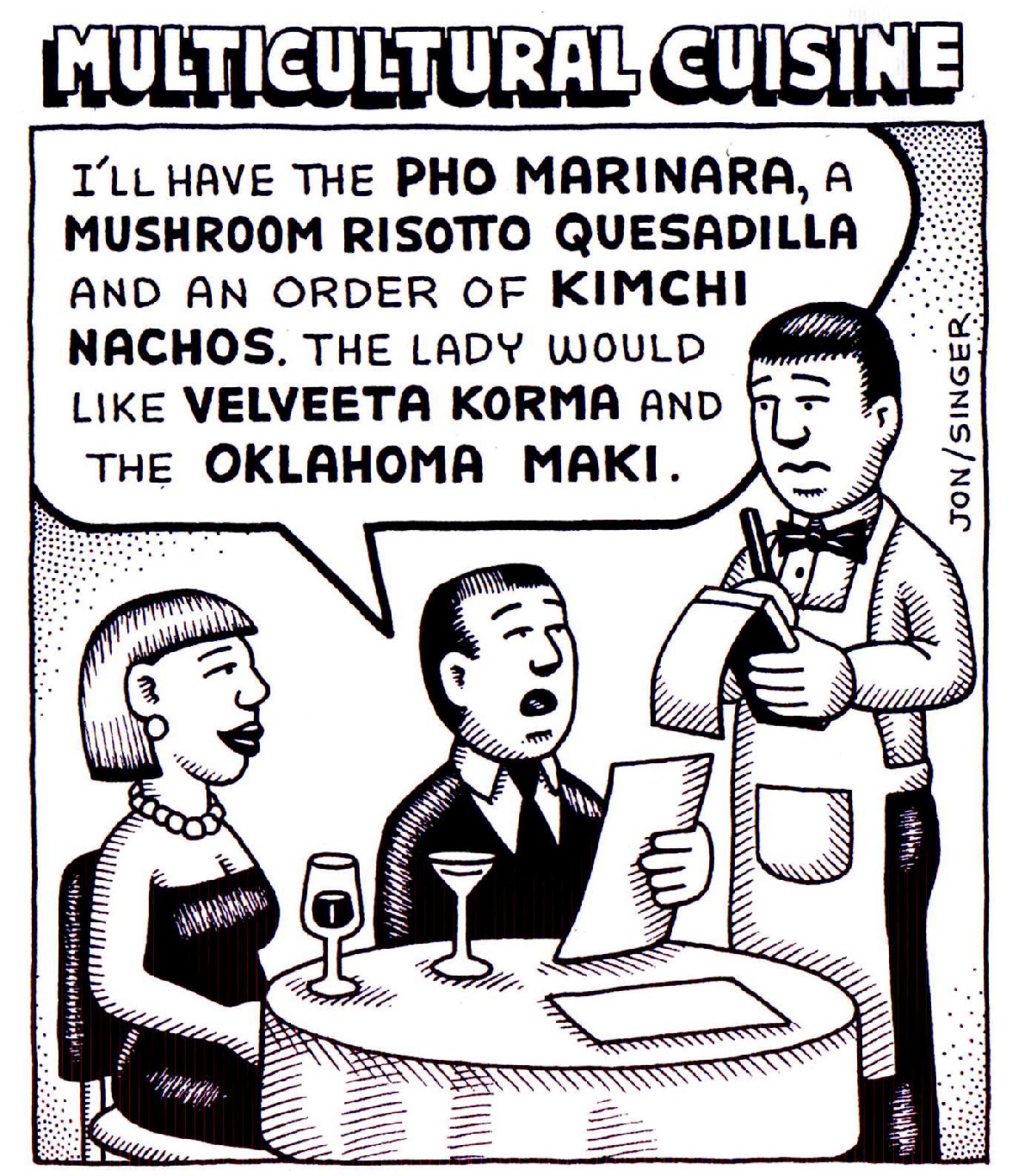
Multicultural
                  Cuisine
Alien
                  Vegetarians
Former
                  McDonalds Clown
  And that's my cuisine in a nutshell, at least for right now... The End...


ARTICHOKE SCRAMBLED EGGS BENEDICT

JAPANESE CABBAGE PANCAKES (Okonomiyaki with its distinctive sauce)

KETO CHILAQUILES!  Also good for Nachos

KEV'S IMPROVISED CINNABON® MUFFINS
These are only "halfway" keto, but you can share them with a friend who is accustomed to Cinnabon

CANTONESE-STYLE EGGS
These scrambled eggs are trendy in restaurants right now, because they are extremely smooth & creamy.

EGG & KALE BREAKFAST QUICHE

MUSHROOMS & EGGS (Czech recipe Houby S Vejci)
Caraway seed is a spice commonly used to flavor sausage, so this recipe "tastes" a lot like it has sausage in it.  However, there is no meat, it is "ovo-lacto".

GARLIC FRENCH TOAST

GRITS SUBSTITUTE (Baked Cottage Cheese & Eggs)

LO-CARB APPLE CINNAMON SCONES

SHAKSUKA

KETO WAFFLES & PANCAKES


CHILE RELLENO CASSEROLE

ARTICHOKE / SPINACH / MUSHROOM CASSEROLE

HUNGARIAN  GOULASH / GOULAJ

LENTIL MUJADDARA WITH YOGURT SAUCE

SPAGHETTI SQUASH LASAGNE (and recap of notes on pasta)

SPINACH-PEPPER ENCHILADAS

PAN FRIED TOFU (also air-fryer tofu)

TOFU-SPINACH FLAN (OR AN UNUSUAL PIZZA)

MAGICAL MYSTERY TACOS

CHICKEN OR EGGPLANT OR TOFU PARMIGIANA

QUINOA CHARD PILAF

TOMATOES (or other stuffed vegetables) WITH "FORCEMEAT" (an old term for fake/vegetarian meat)

ZUCCHINI BOATS


Sylvia's CHOPPED OLIVE "GOODIE"

UNUSUAL FONDUE RECIPES

ROASTED GARLIC
Baking heads of garlic in an oven reduces its sharpness and causes it to "melt," so it can be used as a spread or garnish on crackers or other dishes.  Rub off excess paper skin from the garlic -- but you don't need to separate the heads into cloves -- Use a scissors or a sharp knife to snip the very upper tips off of each garlic clove.  This opens up the cloves from their paper shells.  Then spray or rub with some cooking oil.
Bake at 350 degrees F for 40 to 60 minutes.  When done, the cloves should be golden brown, but not burned.  The garlic cloves should now be semi-liquid and you can usually squeeze them out of their paper shells easily and spread them like butter.

HIPPY SLOPPY SAUCE (a Miso-Tahini sauce)

UNUSUAL PASTA SAUCES (and recap of notes on pasta)

Notes on Pasta:  Some types of low-carb pasta, such as Banza or Ancient Harvest, are made with ingredients such as chickpeas and quinoa, and are _better_ for diabetics but still contain carbs.  Shiritake pasta a.k.a. "miracle noodle" made from a mushroom, is sold packaged in water, has zero carbs, is terribly expensive, has a somewhat different taste & texture than real pasta, but is healthy and works well in recipes.  "Carbe Diem" brand spiked my blood sugar severely, (an example of how labeling of Keto and low-carb products doesn't always guarantee results, and people's metabolism differs).  Palmini imitation pasta is made from hearts of palm and is healthy, but too stiff and fibrous unless cooked thoroughly (might work well for lasagne sheets).
If you prefer something more natural, cooked spaghetti squash works well for most tastes.  It can also be part of breakfast or dessert recipes, such as savory breakfast fritters with eggs (add to the Japanese cabbage pancakes I mentioned).  I have a recipe for spagetti squash coconut pie. 
Some types of Asian noodles, e.g. made with Sweet Potato or Mung Bean instead of semolina flour, can be lesser-carb substitutes for real spaghetti.  But Asian noodles can vary _GREATLY_ in carb content, even the same type of noodle but different brands.  Look at the nutrition labels and try to find Asian noodles with less than 30g carbohydrates per serving.  Some can go as high as 90g.
More notes on Keto lasagna

CZECH DILL SAUCE

CREAMY MISO MUSHROOM SAUCE

Raita with Tadziki

CREAMY THAI COCONUT LIME SAUCE

THAI PEANUT SAUCE